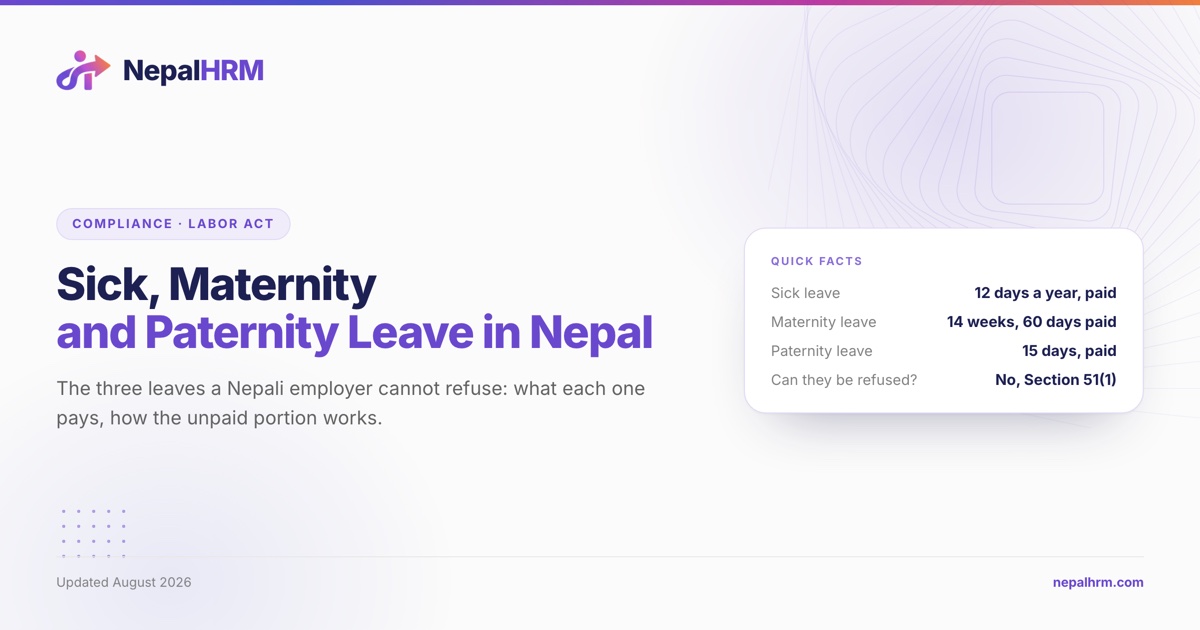
Nepal's Labour Act 2074 sets out eight leaves, and Section 51(1) makes five of them a facility the employer may refuse. Sick leave, maternity leave and mourning leave are the exceptions. They are rights, and a leave policy that routes them through the same discretionary approval as home leave has quietly mixed the two categories.
This guide covers the three leaves most Nepali employers get wrong on pay rather than on entitlement: sick, maternity and paternity leave. What each one gives, exactly how much of it is paid, who pays when the company is in the Social Security Fund, and the documents the Act actually requires. It sits under our guide to leave types under the Labour Act, which covers all eight.
Table of Contents
- The three leaves that cannot be refused
- Sick leave: twelve days, and what happens on day four
- Maternity leave: fourteen weeks, sixty days of pay
- The Section 47 offset: who actually pays
- The document the Act requires
- Paternity leave: fifteen days, and the name it goes by
- What to fix in your policy this week
- Frequently asked questions
- How many days of maternity leave are there in Nepal?
- Is maternity leave fully paid in Nepal?
- How many days of paternity leave are there in Nepal?
- Can an employer refuse sick leave in Nepal?
- Does the employer pay for maternity leave if the company contributes to the SSF?
- How many sick leave days can be accumulated in Nepal?
- Is a medical certificate required for sick leave in Nepal?
- Sources
The three leaves that cannot be refused
Section 51(1) is the provision that decides how a leave policy is enforced, and it is almost never quoted:
The leaves other than sick leave, mourning leave and maternity leave receivable by a labour under this Chapter are only facilities and cannot be claimed as a matter of right.
Section 51(2) then gives the employer, for every other leave, the power to refuse, postpone, deduct or reschedule it according to the needs of the work, stating the reason.
The consequence is a two-tier policy, and most Nepali handbooks are written as if there were one tier:
| Sick, maternity, mourning | Home, substitute, and the rest | |
|---|---|---|
| Legal character | Right | Facility, Section 51(1) |
| Can be refused | No | Yes, with a recorded reason |
| Can be rescheduled | No | Yes, Section 51(2) |
| Prior approval | Notification, not permission | Approval |
A sick-leave form that says "subject to approval by the reporting manager" is describing a power the employer does not have. The correct mechanism is notification plus, where the Act requires it, evidence.
Sick leave: twelve days, and what happens on day four
Section 44(1) gives twelve days of paid sick leave a year, with a proviso pro-rating the entitlement for a worker who has served a year or less. See sick leave for the term on its own.
Two procedural rules sit underneath it, and both are routinely enforced as though they said something else.
Section 44(2): a certificate is required past three consecutive days. A worker asking for more than three consecutive days of sick leave must produce a certificate from a recognised physician. "Three days" is a run of days, not a running annual total. A policy demanding a medical certificate for the fourth single-day absence of the year is asking for something the Act does not require.
Section 44(3): notification is immediate, not on return. Where illness is sudden, the worker must inform the employer, or the person the employer designates, by the fastest available means. This is worth writing into the policy verbatim, along with the name or role of that designated person, because "fastest available means" is only enforceable if the worker knows where to send it.
Three further points that most summaries get wrong:
- Sick leave accumulates. Section 49(1) sets a ceiling of forty-five days. It is a different number from the ninety-day home leave ceiling, and the widely republished summaries of this Act state one flat ninety for both.
- Sick leave is encashable. Section 49(2) pays out accumulated home and sick leave on separation or death, at the last basic remuneration drawn.
- Anything above the ceiling is not lost. Section 49(3) pays out the excess at the end of each year at the basic rate. Our guide to leave encashment and its tax treatment covers what that costs and how it is taxed.
Maternity leave: fourteen weeks, sixty days of pay
Section 45 is the longest leave provision in the Act and the most often summarised wrongly. Taken sub-clause by sub-clause:
| Sub-clause | What it provides |
|---|---|
| 45(1) | Fourteen weeks of maternity leave, before or after delivery |
| 45(2) | At least two weeks before the expected date and six weeks after delivery are compulsory |
| 45(3) | Sixty days carry full remuneration; the balance of the period is unpaid |
| 45(4) | On a recognised physician's recommendation, up to one further month, unpaid or adjusted against other leave, running continuously |
| 45(5) | A stillbirth, or a miscarriage at seven months or more, is treated as a delivery |
| 45(6) | If the mother dies before the child is sixty days old, the surviving worker takes the remaining leave, with remuneration, to care for the infant |
The gap that causes the arguments is between 45(1) and 45(3). Fourteen weeks is ninety-eight days. Sixty of them are paid. The remaining thirty-eight days are unpaid, and a policy that says "fourteen weeks of paid maternity leave" has promised more than the statutory floor and created a contractual entitlement it will be held to.
Granting more than the floor is entirely lawful and many Nepali employers do. The distinction worth keeping is between what the Act requires and what your company has chosen, because only the second can be revised.
Section 45(2) is a duty on the employer, not an option for the employee. The eight-week core around delivery is compulsory leave. An employee who wants to work through it, and a manager willing to let her, are not free to agree otherwise.
See maternity leave for the definition in isolation.
The Section 47 offset: who actually pays
This is the provision no summary mentions and the one with real money in it.
Section 47 provides that where the remuneration for the maternity leave period is receivable from the Social Security Fund, the employer does not have to pay that remuneration to that extent.
If your company contributes to the SSF, the paid portion of maternity leave is a fund claim, not purely a payroll cost. Treating it as a payroll cost means paying it twice: once through the contribution, once through the salary sheet. The compulsory leave does not change; the funding source does.
Our guide to the four SSF schemes and what they pay covers the maternity protection scheme, who qualifies, and what has to be filed. The contribution side is on our SSF contribution calculator.
The document the Act requires
Section 46 obliges a female worker who has taken maternity leave to submit a copy of the prescribed birth registration certificate to the employer, except where the newborn has died.
It is a small clause and it is almost never in a Nepali leave policy, which means the record is missing exactly when an SSF claim or a labour audit needs it. Put it in the policy, with a timeframe, and collect it as part of the return-to-work step rather than chasing it a year later.
Paternity leave: fifteen days, and the name it goes by
Section 45(7) grants a male worker whose wife gives birth fifteen days of leave with remuneration.
The Act calls this maternity-care leave, not paternity leave. The distinction matters when you are searching the Act rather than a summary: the entitlement is a sub-clause of Section 45 rather than a section of its own, which is why it is so often missed entirely.
Fifteen days, paid, with no pro-rating proviso and no service qualification stated in the sub-clause. See paternity leave for the term.
Two practical notes. The days are not stated to be continuous, so whether they can be split is a policy decision you should make explicitly. And because Section 45(7) sits inside the maternity section, it inherits Section 51(1)'s protection: maternity leave is one of the three leaves that cannot be refused.
What to fix in your policy this week
- Does the sick-leave process ask for approval, when the Act gives a right and asks only for notification?
- Does the medical certificate rule trigger on three consecutive days, or on a cumulative count?
- Does the policy name the person to notify for sudden illness?
- Does it say fourteen weeks of maternity leave are paid, when Section 45(3) pays sixty days?
- Is the two-weeks-before, six-weeks-after period written as compulsory?
- If you are in the SSF, is maternity remuneration claimed from the Fund or absorbed by payroll?
- Do you collect the birth registration certificate under Section 46?
- Is paternity leave fifteen paid days, and does the policy say whether it can be split?
- Does sick leave accumulate to forty-five days, or does it lapse each year?
Rights-based leave fails on the arithmetic, not the principle. NepalHRM holds each leave type with its own accrual rule, so sick leave accrues and accumulates against its own ceiling while home leave accrues against another, balances update the moment a request is approved, and holidays falling inside a leave request are resolved by rule rather than by hand. See how leave management works, or book a walkthrough with your own leave types.
Frequently asked questions
How many days of maternity leave are there in Nepal?
Fourteen weeks under Section 45(1) of the Labour Act 2074. Sixty days of that period carry full remuneration under Section 45(3), and the balance is unpaid. At least two weeks before the expected delivery date and six weeks after delivery are compulsory under Section 45(2).
Is maternity leave fully paid in Nepal?
No. Section 45(3) pays sixty days at full remuneration and states that the remainder of the fourteen-week period is unpaid. Many employers pay more as a matter of company policy, but the statutory floor is sixty paid days.
How many days of paternity leave are there in Nepal?
Fifteen paid days. Section 45(7) grants a male worker whose wife gives birth fifteen days of maternity-care leave with remuneration.
Can an employer refuse sick leave in Nepal?
No. Section 51(1) makes sick, mourning and maternity leave rights rather than facilities, so the power in Section 51(2) to refuse, postpone, deduct or reschedule leave does not reach them. The employer can require the evidence the Act specifies: a recognised physician's certificate for more than three consecutive days, under Section 44(2).
Does the employer pay for maternity leave if the company contributes to the SSF?
Not to the extent the Fund pays it. Section 47 relieves the employer of paying maternity-leave remuneration where that remuneration is receivable from the Social Security Fund. The leave entitlement is unchanged; only who funds it changes.
How many sick leave days can be accumulated in Nepal?
Forty-five days, under Section 49(1). That is a different ceiling from the ninety days that applies to home leave. Accumulated sick leave is paid out at the last basic remuneration drawn when the worker leaves service, under Section 49(2), and anything above the ceiling is paid out at the end of each year under Section 49(3).
Is a medical certificate required for sick leave in Nepal?
Only for more than three consecutive days. Section 44(2) requires a certificate from a recognised physician in that case. For shorter absences the Act requires notification by the fastest available means under Section 44(3), not documentary proof.
Sources
- Labour Act, 2074 (2017), consolidated Nepali text as amended through 2082, Nepal Law Commission: lawcommission.gov.np. Sections 44 to 51 were read sub-clause by sub-clause from that text, retrieved 2026-08-07.
Related reading: Leave types under the Labour Act 2074 · Leave encashment in Nepal and how it is taxed · How to write a leave policy for a Nepali company