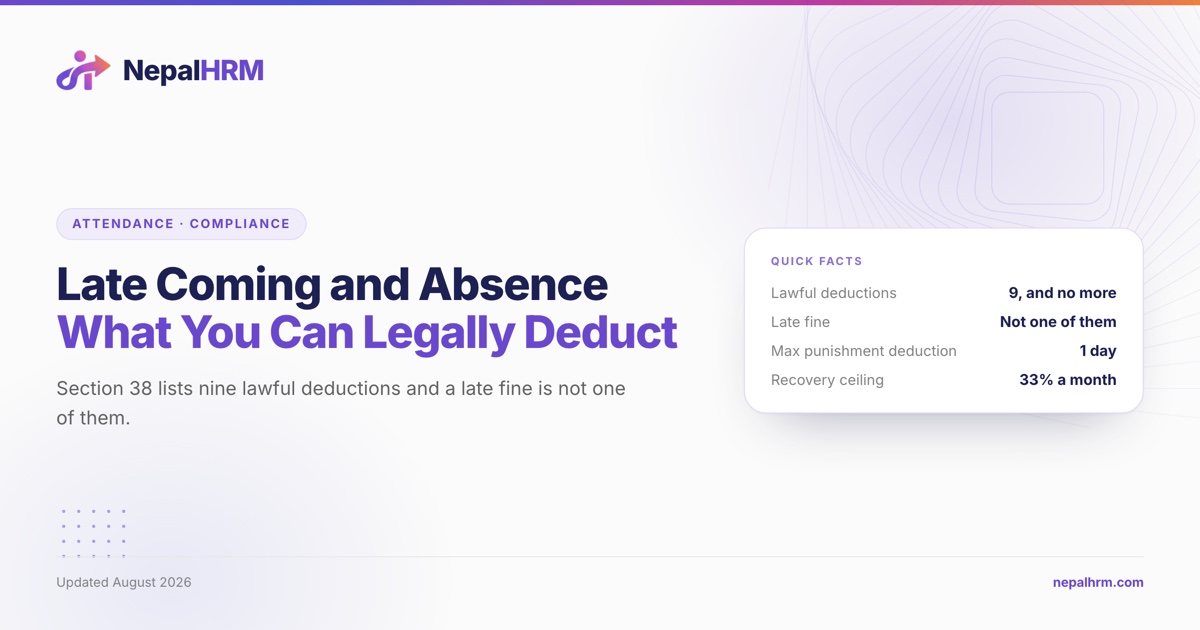
You may leave the time an employee was absent unpaid, under Section 38(1)(e) of the Labour Act 2074. You may not charge a late fine. Section 38(1) opens with "except in the following circumstance, no amount shall be deducted from the remuneration receivable by the labour" and then lists nine circumstances. A fixed penalty for arriving late is not on the list, and a list that begins with "except" is a closed one.
That is the whole answer, and almost every Nepali late-coming policy gets it wrong in the same direction. What the Act does give you is a discipline ladder in Chapter 20 that starts with a reprimand and ends, for long absence, in dismissal. This guide works through both, and sits alongside our attendance policy template for Nepali companies, which is where the rules below have to be written down to be usable.
Table of Contents
- The nine lawful deductions
- The ceilings in Rule 19
- What the Act actually does about lateness
- Absence: the two different problems
- Due process, in five dates
- A compliant late policy, in five rules
- Frequently asked questions
- Can an employer in Nepal deduct salary for coming late?
- What punishment does the Labour Act give for repeated lateness?
- What is the maximum salary deduction allowed as punishment in Nepal?
- How much can an employer recover from a monthly salary in Nepal?
- How many days of absence lead to dismissal in Nepal?
- Does an employee get a hearing before attendance punishment?
- Can a company bye-law create its own late-coming penalty?
- Sources
The nine lawful deductions
| Section 38(1) | What it permits |
|---|---|
| (a) | Any tax or fee leviable under law |
| (b) | Provident fund, insurance or other social security contribution |
| (c) | An amount ordered by a judicial or quasi-judicial body, or by arbitration |
| (d) | The prescribed amount for a service or facility the employer provides |
| (e) | Remuneration for the period the worker remains absent from work |
| (f) | Loss of or damage to the employer's cash or goods caused with ulterior motive or recklessly, at book value or production cost |
| (g) | An amount the collective agreement specifies as deductible |
| (h) | Trade union membership fee |
| (i) | A loan or advance the employer provided |
Read (e) carefully, because it is the one that carries all the weight. It does not authorise a penalty proportional to lateness. It authorises not paying for time not worked. Thirty minutes absent is thirty minutes of pay, not an hour of pay as a deterrent and not a flat NPR 200.
Section 38(2) then fixes the order. When deducting under (c) through (i), you deduct from the monthly remuneration that remains after the amounts in (a) tax and (b) social security have come out. A recovery calculated on gross is calculated on the wrong base.
The ceilings in Rule 19
Section 38(3) leaves the limit and the procedure to be prescribed, and Rule 19 of the Labour Rules 2075 prescribes them. This is the part almost no Nepali HR article carries:
| Situation | Ceiling |
|---|---|
| Judicial or quasi-judicial order under 38(1)(c), no period stated in the order | 50% of monthly remuneration, until recovered |
| A service or facility provided under 38(1)(d) | 33% of monthly remuneration |
| Loss or damage under 38(1)(f) | 33% of monthly remuneration |
| A percentage fixed in the collective agreement under 38(1)(g) | Whatever the agreement fixes |
| The employment is ending and 33% will not recover it | A higher rate, judged on the employment period, time or work |
Rule 19(6) adds the base. Those percentages are worked out on what remains after setting aside the worker's trade union dues, collective bargaining fee and Citizen Investment Trust deposits. On a NPR 30,000 monthly remuneration the 33% ceiling is roughly NPR 9,900 before those set-asides, and less after them.
Note what has no entry in this table: lateness. There is no ceiling for a late deduction because there is no late deduction.
What the Act actually does about lateness
Chapter 20 is a ladder, and each rung has its own list of misconduct. The interesting thing is where lateness appears, and where it does not.
Section 131(1): reprimand. Remaining absent without sanctioned leave, leaving the workplace without the manager's permission, appearing late in work frequently without obtaining permission, disobeying a work order, and any other misconduct the bye-law specifies.
Section 131(2): deduction of at most one day's remuneration. Refusing to receive the employer's letter or notice, taking part in or forcing an illegal strike or collective go-slow, causing loss by recklessly cutting production or service, attempting to take a benefit on false documents, and failing to use safety equipment you were given. Lateness is not on this list.
Section 131(3): annual increment or promotion withheld for one year. Taking enterprise property out without permission, attempting embezzlement, reckless damage to property, cutting off food, water, telephone or electricity or blocking movement in the workplace, and intentionally misusing or damaging goods kept for workers' benefit, safety or health.
Section 131(4): dismissal. Thirteen grounds, including absence for more than thirty consecutive days without sanctioned leave at (f), and at (l), being punished more than twice under sub-sections (1), (2) and (3) within three years.
That last one is the mechanism that makes a reprimand worth issuing. On its own a reprimand changes nothing. Three of them inside three years is a dismissal ground under 131(4)(l), which is why the reprimand has to be written, dated and filed rather than delivered across a desk.
Absence: the two different problems
Absence you can price. A day not worked is a day not paid, under Section 38(1)(e). Nepali payroll conventionally divides the monthly figure by thirty to get a daily rate, so NPR 30,000 a month gives NPR 1,000 a day and a half-day absence is NPR 500. That thirty-day divisor is convention, not statute: the Act nowhere states a divisor, so whichever you use has to be in the contract or the bye-law and has to stay the same all year.
Absence you cannot price. Once absence passes thirty consecutive days without sanctioned leave it stops being a payroll line and becomes Section 131(4)(f). At that point the question is process, not arithmetic, and the process is below.
Weekly leave stays paid throughout. Rule 20 of the Labour Rules 2075 requires the employer to pay remuneration for the period of weekly leave, so a week with an unpaid absence in it does not become a week with an unpaid weekly leave day.
Due process, in five dates
Section 139(2) requires proper and sufficient reason for terminating employment, and Chapter 20 is where that reason gets built. Miss a date and the reason is defective however true the underlying facts are.
- Knowledge. Section 137(1): action must commence within two months from the date you knew of the misconduct. A punch log from four months ago is evidence of a fact you are now out of time to act on.
- Show cause. Section 135: before punishing, the punishing authority gives a notice allowing seven days to submit a clarification. The notice must clearly state the facts of the misconduct and the punishment possible if it is proved. A notice that omits the possible punishment is not a Section 135 notice.
- Decision. Section 137(2): within three months of commencing the action.
- Authority. Section 136(1): the chief executive of the enterprise decides, unless the bye-law empowers a managerial-level worker to investigate and take the final decision under 136(2).
- Suspension, if any. Section 134(2) allows suspension where it is inappropriate to keep the worker on the job while a Section 131(4) punishment is proposed, or where they may destroy evidence. Not more than three months, extendable by one if the investigation is unfinished, and the worker draws half remuneration throughout. If they are cleared, 134(5) restores the balance and any increment.
Section 138(1) lets you propose a higher punishment and impose a lower one, so the ladder can be climbed down. It cannot be climbed above the top of the chapter.
A compliant late policy, in five rules
- Late is unpaid time, not a fine. Deduct the minutes actually absent under Section 38(1)(e), or do not deduct at all.
- Frequency is the misconduct, not the incident. Section 131(1)(c) says "frequently", so define what frequent means in the bye-law and count it over a stated window.
- Write the reprimand. It is the only punishment Section 131(1) offers, and three punishments in three years is what 131(4)(l) needs.
- Never invent a rung. No half-day deduction for three lates, no salary cut for a fourth. Section 138(2) recognises lighter punishment than the Act; it does not recognise heavier.
- Keep the evidence for five years. Rule 81(3) requires attendance and remuneration records to be kept for at least five years, and a punishment you cannot evidence is a termination you cannot defend.
Where hours beyond the shift are involved rather than hours missing from it, the arithmetic runs the other way: our overtime rules in Nepal guide covers the Section 30 caps and the Section 31 rate, and /tools/overtime-calculator prices an actual month.
The deduction is easy. The evidence is the work. NepalHRM builds each day from real punches against the assigned shift, separates absent time from approved leave, and keeps the original record beside every regularisation with the approver's name on it. It prices what you tell it to price, so the Section 38 discipline stays with your policy rather than with the software. See how attendance works, or book a walkthrough.
Frequently asked questions
Can an employer in Nepal deduct salary for coming late?
Only for the time actually not worked, under Section 38(1)(e) of the Labour Act 2074. A fixed late fine is not one of the nine deductions Section 38(1) permits, and Section 38(1) is a closed list.
What punishment does the Labour Act give for repeated lateness?
A reprimand. Section 131(1)(c) lists appearing late in work frequently without obtaining permission among the misconducts punishable by reprimand. Under Section 131(4)(l), being punished more than twice under sub-sections (1), (2) and (3) within three years is itself a ground for dismissal.
What is the maximum salary deduction allowed as punishment in Nepal?
One day's remuneration. Section 131(2) permits a deduction of at most one day for the misconducts it lists, and no other provision in Chapter 20 permits a larger one.
How much can an employer recover from a monthly salary in Nepal?
Rule 19 of the Labour Rules 2075 caps recovery at 50% of monthly remuneration for an amount ordered by a judicial or quasi-judicial body where the order sets no period, and at 33% for a priced service or facility and for loss or damage under Section 38(1)(f). The percentage is computed after union dues, collective bargaining fee and Citizen Investment Trust deposits are set aside.
How many days of absence lead to dismissal in Nepal?
More than thirty consecutive days without sanctioned leave, under Section 131(4)(f). Shorter absence is unpaid under Section 38(1)(e) and, if unauthorised, is misconduct punishable by reprimand under Section 131(1)(a).
Does an employee get a hearing before attendance punishment?
Yes. Section 135 requires the punishing authority to give a notice allowing seven days to submit a clarification, stating the facts of the misconduct and the punishment possible if it is proved.
Can a company bye-law create its own late-coming penalty?
Only a lighter one. Section 138(2) applies a bye-law that provides lesser punishment than Chapter 20 allows, and Section 108(6) lets a court void a bye-law provision that contradicts the Act.
Sources
- Labour Act, 2074 (2017), consolidated Nepali text as amended through 2082, Nepal Law Commission: lawcommission.gov.np. Sections 38, 108, 130, 131, 134 to 139 were read from that text, retrieved 2026-08-07.
- Labour Rules, 2075 (2018), Nepal Law Commission. Rule 19 (method of deducting remuneration), Rule 20 (remuneration for weekly leave) and Rule 81 (five-year record retention), retrieved 2026-08-07.
Related reading: Attendance policy for Nepali companies · Overtime rules in Nepal · Termination and notice period in Nepal