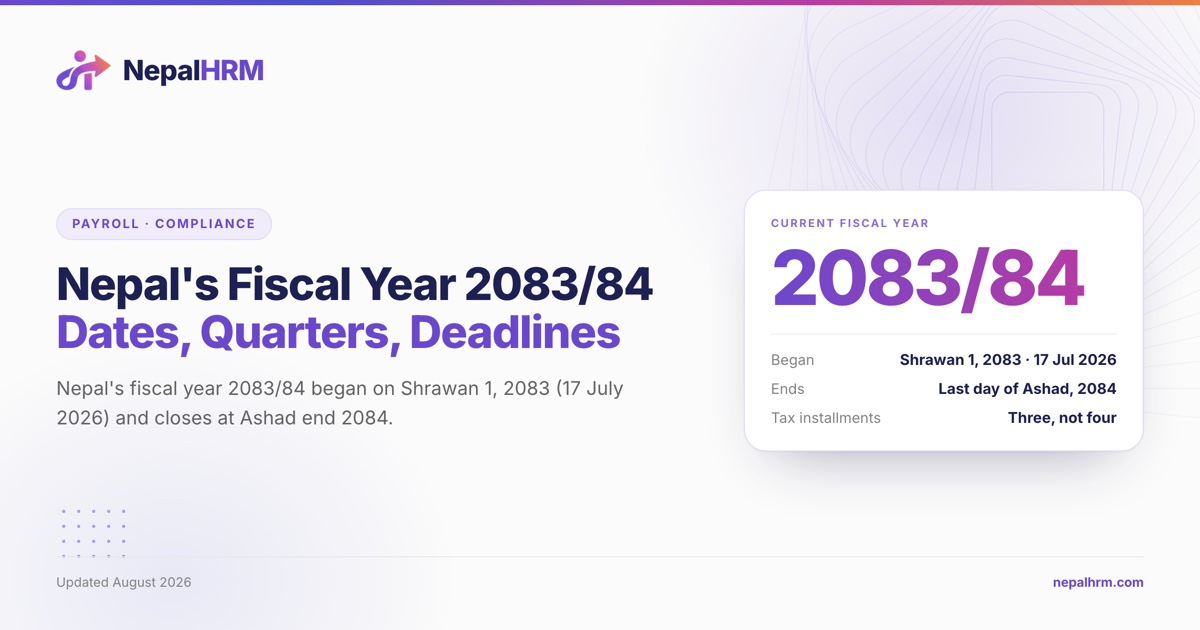
Nepal's current fiscal year is 2083/84. It began on Shrawan 1, 2083, which was Friday 17 July 2026, and it runs to the last day of Ashad 2084, in the middle of July 2027. The previous year, 2082/83, closed on Ashad 32, 2083, which was 16 July 2026.
That is the whole answer to the question most people are asking. The rest of this page is the part that costs money if you get it wrong: what the law actually anchors to those two dates, why Nepal has three tax installments instead of four quarters, and the deadline map for the year now running. If you are moving systems at the boundary, our guide to switching HR and payroll software at the new fiscal year covers that separately.
Table of Contents
- Which fiscal year is running, and its exact dates
- Why the Gregorian date moves every year
- Nepal's fiscal year does not have quarters
- What actually changes on Shrawan 1
- The deadline map for FY 2083/84
- Why this matters to a payroll team
- Frequently asked questions
- What is the current fiscal year in Nepal?
- When does the fiscal year start in Nepal?
- When does Nepal's fiscal year end?
- Does Nepal's fiscal year have quarters?
- What are the fiscal year 2083/84 dates in the English calendar?
- Which year does my company's leave entitlement follow?
- When do new income tax rates apply in Nepal?
- Is the fiscal year the same as the Bikram Sambat calendar year?
- Sources
Which fiscal year is running, and its exact dates
| Fiscal year | Starts | Ends |
|---|---|---|
| 2082/83 | Shrawan 1, 2082 | Ashad 32, 2083 · 16 Jul 2026 |
| 2083/84 | Shrawan 1, 2083 · 17 Jul 2026 | Ashad end, 2084 · mid-Jul 2027 |
| 2084/85 | Shrawan 1, 2084 | Ashad end, 2085 |
The two-number name confuses people who are used to a single year. A Nepali fiscal year is written 2083/84 because it starts in Bikram Sambat 2083 and finishes in 2084: Shrawan, Bhadra, Ashoj, Kartik, Mangsir and Poush fall in the first BS year, and Magh, Falgun, Chaitra, Baishakh, Jestha and Ashad fall in the second. See Nepali fiscal year for the short definition.
Why the Gregorian date moves every year
Section 2(jha) of the Income Tax Act 2058 defines the income year as the period from Shrawan 1 of one year to Ashad masanta of the next. Masanta means the last day of the month, not the thirty-first. Bikram Sambat months run 29 to 32 days, and the length of any given month is fixed by the calendar rather than by statute, so the closing date is a moving target in Gregorian terms.
Ashad 2083 ran to 32 days, so FY 2082/83 ended on 16 July 2026 and FY 2083/84 opened the next day. A year in which Ashad runs 31 days closes a day earlier. Anyone hard-coding "16 July" into a payroll calendar is coding a coincidence.
The practical consequence: state your fiscal-year boundary in Bikram Sambat, and derive the Gregorian date from the published calendar for that year. Doing it the other way round produces a payroll period that is one day short or one day long, and every attendance, leave and withholding total then disagrees with the government's.
Nepal's fiscal year does not have quarters
This is the single most common wrong assumption in Nepali reporting packs, usually imported from an Indian or Western template. Nothing in the Income Tax Act creates a quarter. What it creates is a three-installment advance tax schedule in Section 94, and the intervals are not equal.
| Installment | Due | Cumulative share of estimated tax | FY 2083/84 date |
|---|---|---|---|
| First | Poush end | 40% | Poush 30, 2083 · 14 Jan 2027 |
| Second | Chaitra end | 70% | Chaitra 30, 2083 · 13 Apr 2027 |
| Third | Ashad end | 100% | Ashad end, 2084 |
Each figure is cumulative and net of tax already paid, including tax already withheld from your payments during the year. Section 94(2) waives an installment worth less than NPR 2,000.
So the year splits 6 months, 3 months, 3 months, not four times three. The first installment date is also the deadline for the estimated-tax return under Section 95(1), which is due on the day the first installment is due.
If you still need four columns for a board pack, the honest mapping is arithmetic and not statutory, and should be labelled that way: Shrawan to Ashoj, Kartik to Poush, Magh to Chaitra, Baishakh to Ashad. Just do not call the second one "Q2 tax" in the same document where finance is paying 40% of the year's estimate.
What actually changes on Shrawan 1
Four things reset with the year, and three of them are in statute rather than in practice.
Income tax. The Finance Act 2083 was published in the Gazette on 2083/03/30, two days before the old year ended. Its Section 1(2) puts most sections into force immediately but leaves the rest, including Section 57 which amends the Income Tax Act 2058, to commence from Shrawan 1, 2083. The new slab table therefore applies to the first payroll of the new year and not to the last one of the old. Numbers live in the salary tax calculator and in income tax slabs in Nepal, which are kept current rather than restated here.
Minimum wage. Section 106(1) of the Labour Act 2074 requires the Ministry to fix minimum remuneration every two years, on the recommendation of the Minimum Remuneration Fixation Committee, and Section 106(3) requires it to be published in the Nepal Gazette. Section 106(4) then fixes when it bites: from the first day of the new fiscal year, unless a trade union and the employer have agreed otherwise. A wage revision that lands mid-year is not a favour, it is late. See minimum wage.
The leave year. Section 50 of the Labour Act sets the order of authority for counting a year for leave purposes: as fixed by law, failing that as fixed by the regulator, failing that as stated in the employment contract, and failing all three, according to the Government of Nepal's fiscal year. Most Nepali employers never write a leave year into the contract, which means most Nepali employers have a Shrawan to Ashad leave year whether they know it or not.
Festival expense. Section 37(2) allows a worker to claim the festival expense once in a fiscal year, in writing, for the festival their own religion and culture observes. Where no such request is made, it is paid at Dashain. The entitlement is one month's basic remuneration under Section 37(1), pro-rated under Section 37(3) for anyone short of a year's service on the payment date. See festival expense.
The deadline map for FY 2083/84
| Obligation | Authority | Due |
|---|---|---|
| Monthly TDS statement and deposit | Income Tax Act §90(1), §90(2) | Within 25 days of each Nepali month end |
| Monthly SSF contribution | Contribution Based Social Security Act §4(4) | Within 25 days of month end |
| Estimated tax return and first installment | §95(1), §94 | Poush end · 14 Jan 2027 |
| Labour audit report, Schedule 10 | Labour Act §100, Labour Rules §56 | End of Poush · 14 Jan 2027 |
| Second installment, 70% | §94 | Chaitra end · 13 Apr 2027 |
| Third installment, 100% | §94 | Ashad end, 2084 |
| Annual tax withholding certificate to each employee | §91(3)(b) | Within 30 days of the year ending |
| Income return | §96(1) | Within three months of the year ending |
Two of those rows are commonly cited wrong, because the widely circulated English translation of the Income Tax Act is the 2002 original and predates the amendments. Sections 90 and 91 both said fifteen days when the Act was passed. The consolidated Nepali text, as amended through the Finance Act 2082, says twenty-five in both places. The same trap catches the Social Security Fund deposit deadline, which also moved from 15 to 25 days.
Why this matters to a payroll team
A company operating in Nepal keeps two clocks. Invoices, bank statements and most software default to Gregorian months. Tax slabs, leave accrual, the withholding statement, the festival expense and the minimum wage all move on Bikram Sambat months. Every reconciliation between the two is a manual step, and manual steps are where the errors are.
The fix is not a conversion spreadsheet, it is running payroll on the Nepali month in the first place, so that the period the payslip covers is the period the statement reports. NepalHRM runs payroll on Bikram Sambat months, carries the fiscal-year boundary through leave balances and tax computation, and produces the IRD eTDS file ready to upload rather than a workbook somebody retypes. See how payroll works, or book a walkthrough.
Frequently asked questions
What is the current fiscal year in Nepal?
FY 2083/84. It began on Shrawan 1, 2083, which was 17 July 2026, and runs to the last day of Ashad 2084 in mid-July 2027.
When does the fiscal year start in Nepal?
On the first day of Shrawan, which falls in mid-July. Section 2 of the Income Tax Act 2058 defines the income year as running from Shrawan 1 of one year to the last day of Ashad of the next.
When does Nepal's fiscal year end?
On Ashad masanta, the last day of Ashad. Because Bikram Sambat months run between 29 and 32 days, that is Ashad 31 in some years and Ashad 32 in others. FY 2082/83 ended on Ashad 32, 2083, which was 16 July 2026.
Does Nepal's fiscal year have quarters?
Not in law. The Income Tax Act 2058 sets three advance-tax installments instead, at the end of Poush, Chaitra and Ashad, carrying 40%, 70% and 100% of the estimated tax cumulatively. Any four-quarter view of a Nepali fiscal year is a reporting convention layered on top of that.
What are the fiscal year 2083/84 dates in the English calendar?
It started on 17 July 2026 and ends in mid-July 2027. The exact closing date depends on whether Ashad 2084 runs 31 or 32 days, which the calendar fixes rather than the Act.
Which year does my company's leave entitlement follow?
Whatever your employment contract says. If the contract is silent and no law or regulator has fixed one, Section 50 of the Labour Act 2074 makes it the Government of Nepal's fiscal year, so leave accrues and resets Shrawan to Ashad.
When do new income tax rates apply in Nepal?
From the first day of the fiscal year they are announced for. The Finance Act 2083 was gazetted on 2083/03/30, and its Section 1(2) commenced the Income Tax Act amendments on Shrawan 1, 2083, so FY 2083/84's rates applied from the first payroll of that year.
Is the fiscal year the same as the Bikram Sambat calendar year?
No. The Bikram Sambat year starts on Baishakh 1, in mid-April. The fiscal year starts three months later on Shrawan 1, in mid-July, and therefore spans two Bikram Sambat years, which is why it is written as 2083/84.
Sources
- Income Tax Act, 2058 (2002), consolidated Nepali text as amended by the Finance Act 2082, Inland Revenue Department: ird.gov.np. Sections 2, 90, 91, 94, 95, 96 and 98 were read from that text, retrieved 2026-08-07. The circulating English translation is the 2002 original and states fifteen days in Sections 90 and 91, which the Nepali text no longer does.
- Finance Act, 2083 (आर्थिक ऐन, २०८३), Act No. 10 of 2083, gazetted 2083/03/30, Nepal Law Commission. Section 1(2) for commencement and Section 57 for the Income Tax Act amendments.
- Labour Act, 2074 (2017), consolidated Nepali text as amended through 2082, Nepal Law Commission: lawcommission.gov.np. Sections 37, 50, 100 and 106.
- Bikram Sambat month lengths for 2083 are taken from the Ministry of Home Affairs public holiday notice for 2083 (Nepal Rajpatra, Khanda 75, Sankhya 67, Bhag 5), whose clause 1 lists every Saturday of the year and therefore pins each month's length.
Related reading: Payroll year-end checklist for Nepal · Salary increment in Nepal · Switching HR and payroll software at the new fiscal year