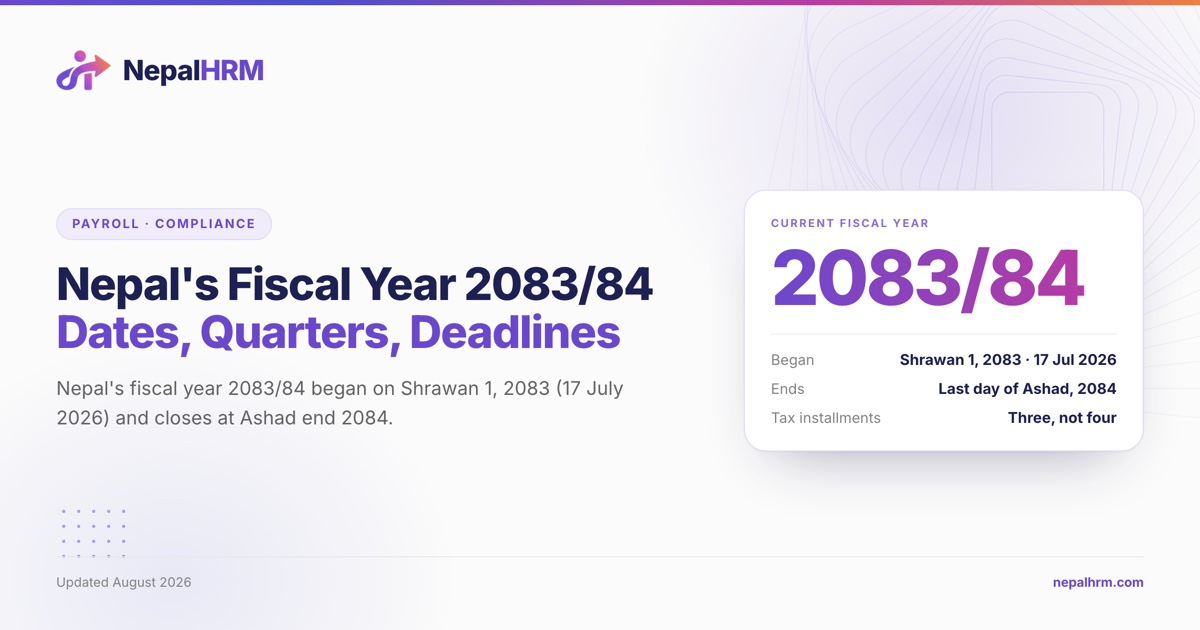
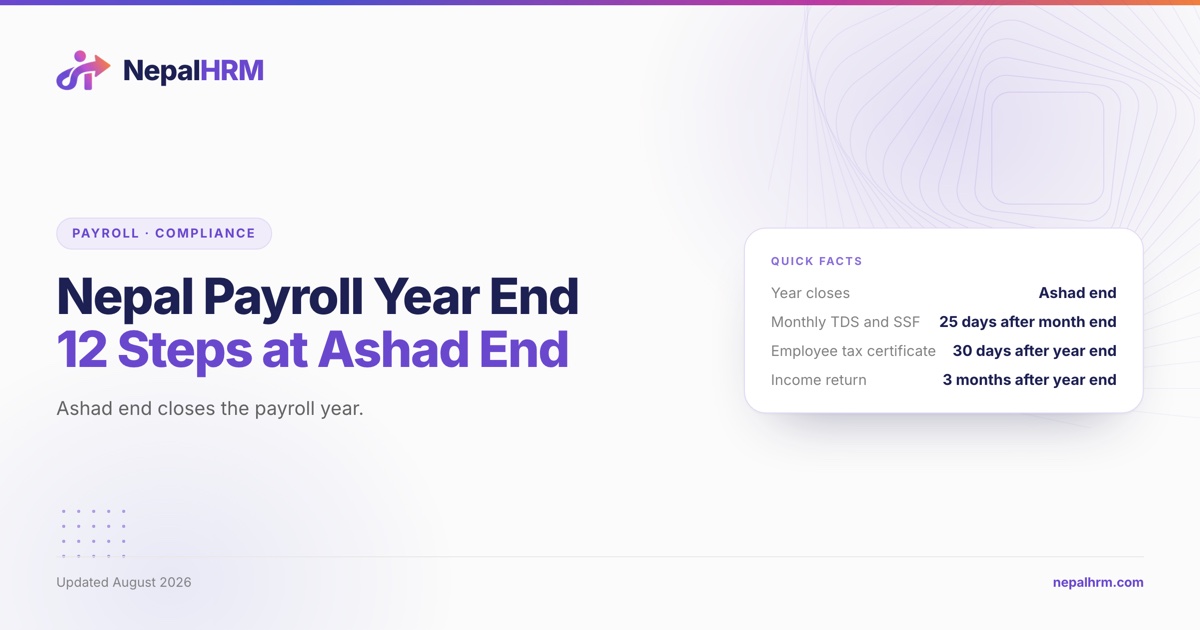
The Nepali payroll year closes at Ashad masanta, the last day of Ashad, and the work that follows it is dated by statute rather than by preference. FY 2082/83 closed on Ashad 32, 2083, which was 16 July 2026, and the deadlines it triggered run from the tenth of August to the middle of October.
What follows is a twelve-step close, in the order it has to happen, with the section that requires each step and the date it falls due. It sits alongside our guide to switching HR and payroll software at the fiscal-year boundary, which covers the migration side of the same window, and assumes you already know how Nepal's fiscal year is dated.
Table of Contents
- 1. Fix the closing date before you close anything
- 2. Run the final Ashad payroll and pay it on time
- 3. File the Ashad TDS statement within 25 days
- 4. Reconcile twelve months of TDS against each employee's annual tax
- 5. Issue the annual tax withholding certificate within 30 days
- 6. Settle the third income tax installment at Ashad end
- 7. Reconcile the retirement contributions for all twelve months
- 8. Pay out leave above the accumulation ceilings
- 9. Close the leave year and open the new balances
- 10. Clear final settlements for anyone who left
- 11. Load the new year before the first run, not after it
- 12. File the income return, and do not rely on the extension
- Frequently asked questions
- What is Nepal's financial year closing date?
- When is the annual TDS certificate due to employees in Nepal?
- What is the deadline for the monthly TDS statement in Nepal?
- When is the annual income return due in Nepal?
- What happens if leave is not used by the end of the year?
- Do I have to close payroll on Nepali months rather than English ones?
- What is the penalty for filing the income return late in Nepal?
- Sources
1. Fix the closing date before you close anything
Ashad has 31 days in some years and 32 in others, and the payroll period has to match the fiscal year exactly. Section 2 of the Income Tax Act 2058 defines the income year as ending on Ashad masanta, so the last period of the year is however many days that month actually ran.
Get this wrong by a day and every downstream total is wrong by a day: the attendance summary, the leave accrual, the withholding statement and the annual reconciliation each drift separately, and each has to be found by hand later.
2. Run the final Ashad payroll and pay it on time
Section 34(1) of the Labour Act 2074 entitles a worker to remuneration and benefits from the date work commenced, and Section 35(2) caps the interval between payments at one month. Two categories are tighter: anyone working less than a month is paid within three days of the work ending, and a casual worker is paid as soon as the work finishes.
Close the run with the year's last attendance, overtime and unpaid-day adjustments already posted. Overtime is 1.5 times the basic hourly rate under Section 31(1), and anything left unposted at the close becomes an arrear you pay in the new year against the old year's tax table. See overtime rules in Nepal.
3. File the Ashad TDS statement within 25 days
Section 90(1) requires the withholding agent to submit a statement to the Department within twenty-five days of the end of each month, in the format the Department prescribes, and Section 90(2) requires the tax withheld to be deposited with that statement, inside the same window.
For Ashad 2083 that fell on Shrawan 25, 2083, which was Monday 10 August 2026. Miss it and Section 119(1) charges interest at the normal interest rate, defined in Section 2 as 15% a year, for every month and part of a month the tax stays unpaid.
The number to check here is the deadline itself. The English translation of the Act still reads fifteen days, because it is the 2002 original. The consolidated Nepali text, as amended, reads twenty-five in both Section 90 and Section 91.
4. Reconcile twelve months of TDS against each employee's annual tax
Nepali salary withholding is a projection, not twelve independent calculations. Every mid-year change moves the annual figure and therefore every remaining month: a revision, a bonus, a festival expense, a joiner, a leaver, a switch between provident fund and the Social Security Fund.
At the close, recompute each employee's annual taxable income and compare it with what was actually withheld across the twelve statements. Where they disagree, the reconciliation belongs in the final period rather than in the new year. The salary tax calculator reproduces the same slab math if you want to check one employee by hand.
5. Issue the annual tax withholding certificate within 30 days
Section 91(3) sets a different rule for employment withholding than for everything else. The certificate covers only the period the employee remained in service during that income year, under clause (a), and clause (b) requires it within thirty days of the year ending, or within thirty days of the employee leaving if they left mid-year.
For FY 2082/83 that deadline was Shrawan 30, 2083, which was 15 August 2026. This is the document employees need for a personal return, a loan application or a visa file, and it is the one year-end obligation most likely to be forgotten, because nothing bounces when you skip it.
6. Settle the third income tax installment at Ashad end
Section 94(1) makes the third installment due by the end of Ashad, and it is cumulative: 100% of the estimated tax for the year, less what has already been paid, including tax already withheld from your own receipts. The first two were 40% by Poush end and 70% by Chaitra end.
Section 118 is the reason to take the estimate seriously. If what you paid per installment falls below 90% of what the correct estimate would have required, interest runs at the normal 15% rate from each installment date. Section 94(2) waives an installment below NPR 2,000.
7. Reconcile the retirement contributions for all twelve months
Under the Social Security Fund, the employee contributes 11% and the employer 20% of basic remuneration, and Section 4(4) of the Contribution Based Social Security Act 2074 requires the deposit within twenty-five days of the month end. That deadline moved from 15 days to 25 by amendment, so a calendar built a few years ago is wrong.
Where the employer runs the old arrangement instead, Section 52(2) of the Labour Act sets provident fund at 10% deducted and 10% matched, and Section 53(2) sets gratuity at 8.33% of basic a month, both from the day work commenced. Reconcile the twelve monthly deposits against the twelve payroll registers before the year is signed off, employee by employee. See six SSF mistakes that cost Nepali employers money.
8. Pay out leave above the accumulation ceilings
Section 49(1) sets two separate ceilings: home leave accumulates to 90 days and sick leave to 45 days. They are not one combined 90.
Section 49(3) then does something most leave policies miss. A worker who accumulates more than those ceilings is entitled to be paid the excess at their basic rate at the end of each year. It is a payment, not a forfeiture, and "each year" is the leave year, which Section 50 makes the fiscal year unless your contract fixes another one.
So the correct year-end sequence is: compute the balance, cap it at 90 and 45, pay the excess in the final payroll, and carry the capped balance forward. See leave encashment and every leave type under the Labour Act.
9. Close the leave year and open the new balances
Section 50 sets the order of authority for counting a leave year: as fixed by law, then by the regulator, then by the employment contract, and failing all of those, according to the Government of Nepal's fiscal year. Most Nepali contracts are silent, which means most Nepali employers reset leave at Shrawan 1 whether their system does or not.
Home leave accrues at one day per twenty days worked under Section 43(1) and sick leave at twelve days a year under Section 44(1), pro-rated below a full year. Open the new year with the carried-forward balance, the new accrual rule and the same ceilings, and record which year each day belongs to. Encashment on separation is paid at the last basic remuneration drawn, under Section 49(2), so the year a day was earned does not change what it is worth.
10. Clear final settlements for anyone who left
Section 148 requires all dues to be paid within fifteen days, and an employer who misses that pays as if the worker were still in service. A leaver in Ashad is therefore not a next-year problem.
The settlement covers unpaid remuneration, accumulated home and sick leave under Section 49(2), gratuity or the Fund position, festival expense pro-rated under Section 37(3), and any notice pay owed under Section 144(2). The withholding certificate for a leaver is due within thirty days of the leaving date, not at the year end. See full and final settlement.
11. Load the new year before the first run, not after it
Four things change at Shrawan 1 and all of them have to be in the system before the first payroll of the new year closes.
- The tax table. The Finance Act 2083 was gazetted on 2083/03/30 and its Section 57, which amends the Income Tax Act, commenced on Shrawan 1, 2083.
- Minimum remuneration, where a revision has been published. Section 106(4) applies it from the first day of the new fiscal year.
- The festival expense plan. One month's basic, once per fiscal year, at Dashain unless the worker asks in writing for their own festival, under Section 37(2).
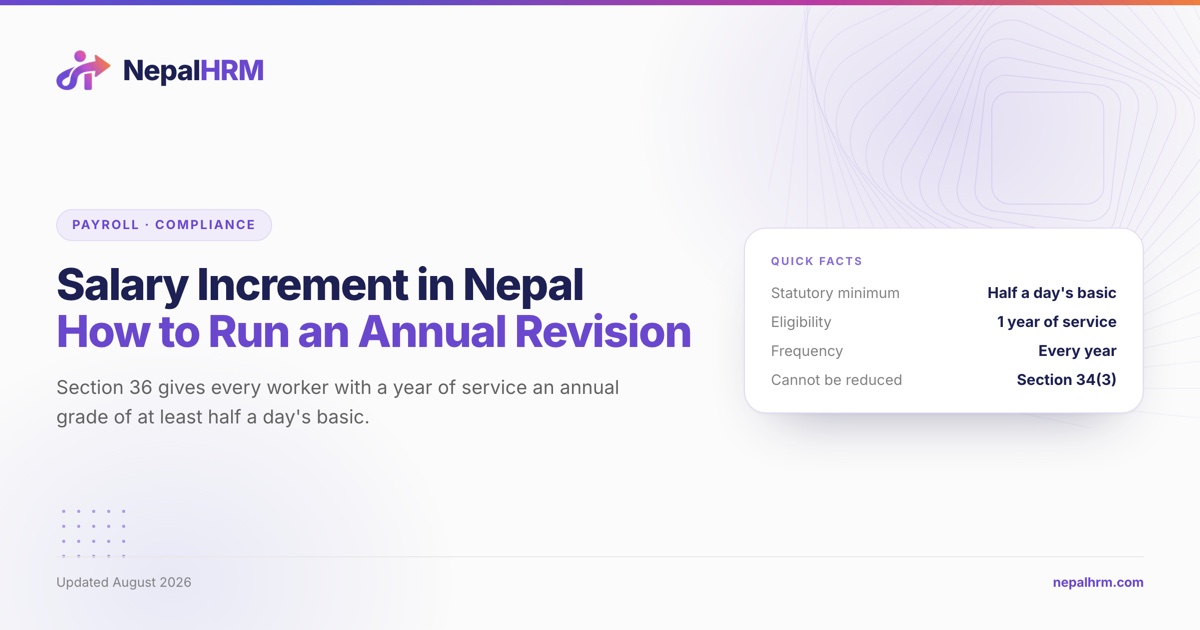
- Annual grade increments, at least half a day's basic under Section 36. Our guide to running an annual salary revision covers the mechanics.
12. File the income return, and do not rely on the extension
Section 96(1) requires the income return within three months of the income year expiring. For FY 2082/83 that is the end of Ashoj 2083, which is Saturday 17 October 2026.
Look at that date against the government's own holiday notice for 2083: Ashoj 31 is the first of the seven consecutive Dashain days. An office planning to file "after the festival" is planning to file late.
Section 98 lets the Department extend the deadline on a written application showing reasonable cause, by up to three months in total, which would carry FY 2082/83 to Poush end, 14 January 2027. Two things make that a poor plan. It is discretionary, and Section 119(2) states plainly that no interest relief is available for the extended period. Late filing itself carries the Section 117(1)(c) fee: 0.1% a year of assessable income computed without deductions, or NPR 1,200 per return, whichever is higher, and NPR 100 a month for a period under a year.
A year-end close is mostly reconciliation, and reconciliation is mostly the cost of two systems disagreeing. NepalHRM runs payroll on Bikram Sambat months, so the period on the payslip is the period on the statement, keeps leave balances and ceilings against the fiscal year, computes annual tax as a projection that reconciles at the close, and produces the IRD eTDS file ready for upload. See how payroll works, or book a walkthrough.
Frequently asked questions
What is Nepal's financial year closing date?
The last day of Ashad, which the Income Tax Act 2058 calls Ashad masanta. It is Ashad 31 in some years and Ashad 32 in others. FY 2082/83 closed on Ashad 32, 2083, which was 16 July 2026.
When is the annual TDS certificate due to employees in Nepal?
Within thirty days of the income year ending, under Section 91(3)(b) of the Income Tax Act 2058, or within thirty days of the leaving date for an employee who left during the year. For FY 2082/83 that was 15 August 2026.
What is the deadline for the monthly TDS statement in Nepal?
Twenty-five days after the end of each Nepali month, under Section 90(1), and the tax is deposited with the statement inside the same window under Section 90(2). The fifteen-day figure still quoted in many places comes from the untranslated 2002 original.
When is the annual income return due in Nepal?
Within three months of the end of the income year, under Section 96(1), so the end of Ashoj. Section 98 allows the Department to extend it by up to three further months on a written application, but Section 119(2) gives no interest relief for the extended period.
What happens if leave is not used by the end of the year?
Home leave accumulates to 90 days and sick leave to 45 under Section 49(1). Anything above those ceilings is paid at the basic rate at the end of the year under Section 49(3). It is an entitlement to payment, not something the employer may cancel.
Do I have to close payroll on Nepali months rather than English ones?
Nothing forbids paying on a Gregorian month, but every statutory report is dated in Bikram Sambat: the withholding statement, the Fund deposit, the leave year and the income year. Running payroll on Gregorian months means reconciling to Nepali months twelve times a year by hand.
What is the penalty for filing the income return late in Nepal?
Section 117(1)(c) charges the higher of 0.1% a year of the assessable income computed without deductions, or NPR 1,200 per return, with NPR 100 a month where the period is under a year. Interest on unpaid tax runs separately at 15% a year under Sections 119(1) and 2.
Sources
- Income Tax Act, 2058 (2002), consolidated Nepali text as amended by the Finance Act 2082, Inland Revenue Department: ird.gov.np. Sections 2, 90, 91, 94, 96, 98, 117, 118 and 119 were read from that text, retrieved 2026-08-07.
- Labour Act, 2074 (2017), consolidated Nepali text as amended through 2082, Nepal Law Commission: lawcommission.gov.np. Sections 31, 34, 35, 36, 37, 43, 44, 49, 50, 52, 53, 106, 144 and 148.
- Contribution Based Social Security Act, 2074, Social Security Fund: ssf.gov.np. Section 4(4) as amended in 2082, for the twenty-five day deposit deadline.
- Finance Act, 2083 (आर्थिक ऐन, २०८३), gazetted 2083/03/30, Sections 1(2) and 57.
- Dashain dates and Bikram Sambat month lengths for 2083 from the Ministry of Home Affairs public holiday notice for 2083 (Nepal Rajpatra, Khanda 75, Sankhya 67, Bhag 5).
Related reading: Nepal's fiscal year explained · Salary increment in Nepal · Labour audit compliance checklist