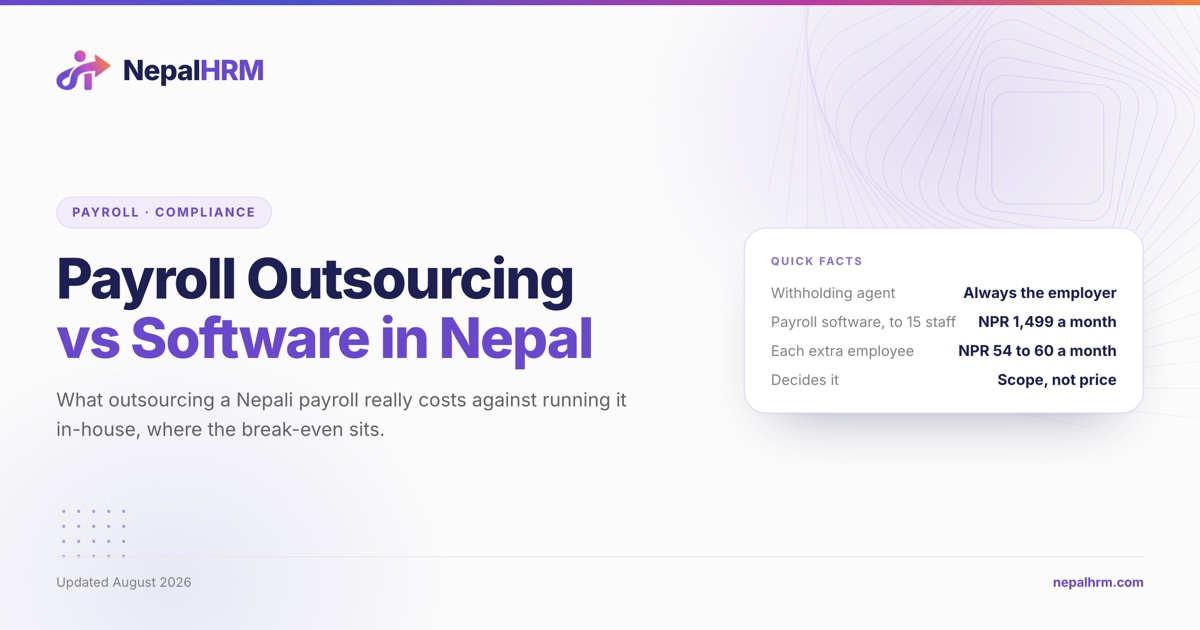
Start with the part that is not a cost question at all: outsourcing your payroll does not outsource the liability. Section 87 of the Income Tax Act 2058 places the duty to withhold on the resident employer, and Section 90(5) makes the withholding agent and the recipient jointly and severally liable when tax is not withheld or not paid over. A service provider processing your run is your agent, not the withholding agent. If they miss a deposit, the Department comes to you.
With that settled, the money. This guide sets out both cost structures honestly, including the parts that do not appear on either invoice. For what the run itself involves, see how to calculate employee salary in Nepal.
Table of Contents
- The two cost structures
- What outsourcing quotes usually leave out
- What in-house software costs, with real numbers
- Doing the comparison properly
- The five questions that actually decide it
- What outsourcing is genuinely good at
- Frequently asked questions
- Does outsourcing payroll transfer the tax liability in Nepal?
- How much does payroll outsourcing cost in Nepal?
- How much does payroll software cost in Nepal?
- When is in-house payroll cheaper than outsourcing?
- What is usually excluded from a payroll outsourcing quote?
- Who lodges the eTDS statement if payroll is outsourced?
- Can we move from outsourcing to in-house mid-year?
- Sources
The two cost structures
They are not the same shape, which is why comparing headline numbers misleads.
| Outsourcing | In-house software | |
|---|---|---|
| Base charge | Per employee per month | Per employee per month |
| Setup | One-off implementation or onboarding fee | One-off configuration, usually your own time |
| Statutory deposits | You still fund them | You still fund them |
| Monthly effort, yours | Send changes, review the output, approve | Enter changes, run, review, approve |
| Effort you cannot avoid | Approving the run, funding the bank file | Same |
| Out of scope, commonly billed extra | Mid-month runs, arrears, final settlements, year-end certificates, statutory filings, reports beyond a standard pack | None of these; they are features or they are not |
| Who holds the data | The provider | You |
| Who is the withholding agent | You | You |
What outsourcing quotes usually leave out
Nepali payroll service quotes are typically per employee per month for a defined scope. The scope is where the real cost lives, so ask each provider to price these explicitly rather than discovering them later:
- Off-cycle runs: a mid-month joiner, an arrear, a correction.
- Final settlements, which are the most labour-intensive run of all and are due within fifteen days under Labour Act Section 148(1).
- Statutory lodgements: is the eTDS statement prepared only, or lodged? Is the SSF deposit schedule prepared only, or deposited? Who holds the portal credentials?
- Annual withholding certificates under Section 91(3).
- Festival expense and bonus runs, which are annual, not monthly.
- Reports beyond the standard pack, including anything your auditor asks for.
- The exit: what happens to historical payroll data if you leave, and in what format.
A quote that covers twelve ordinary monthly runs and prices everything above as extra is not comparable to one that includes them, however similar the per-employee figure looks.
What in-house software costs, with real numbers
Our own pricing, since quoting somebody else's would be guesswork:
| Headcount | Plan | How the month is priced | Monthly | Yearly billing (10 months) |
|---|---|---|---|---|
| Up to 20 | Business | Base fee, 20 employees included | NPR 2,999 | NPR 29,990 |
| 25 | Business | Base fee + 5 × NPR 99 | NPR 3,494 | NPR 34,940 |
| 60 | Business | Base fee + 40 × NPR 99 | NPR 6,959 | NPR 69,590 |
| 120 | Business | Base fee + 80 × NPR 99 + 20 × NPR 89 | NPR 12,699 | NPR 126,990 |
| 250 | Business | Base fee + 80 × NPR 99 + 100 × NPR 89 + 50 × NPR 79 | NPR 23,769 | NPR 237,690 |
Each band prices only the employees inside it: on Business, employees 21–100 cost NPR 99, 101–200 cost NPR 89 and 201–350 cost NPR 79. Yearly billing charges 10 months and waives the one-time setup fee (NPR 5,000 on Business). All figures exclude 13% VAT, which is added to invoices under Nepali law. Full detail on pricing.
The licence is not the cost. The cost is the licence plus the time of whoever runs payroll. Budget that honestly: someone has to enter changes, approve the run, deposit the tax within fifteen days, deposit SSF within twenty-five, and lodge the statement. Our payroll compliance calendar is the list of what that person owns.
Doing the comparison properly
Put both options into the same annual number.
Outsourcing, annual: per-employee rate × headcount × 12, plus setup amortised, plus every out-of-scope item you will actually use, plus your own time reviewing and approving each run.
In-house, annual: licence × headcount × 12, plus 13% VAT, plus the loaded cost of the payroll owner's time, plus whatever your accountant charges to review the output.
Two things fall out of writing it this way.
Below roughly ten people, in-house is free and outsourcing is not. At that size the software costs nothing, and the run is small enough that the same person who does the banking can do it.
Above a few hundred people, the per-employee rates converge and the decision stops being about price. It becomes a question of whether you want payroll expertise inside the company or bought in.
In the middle, the deciding variable is not headcount, it is capability. If nobody in the organisation can confidently answer "when is SSF due and what happens if it is late", a provider is buying you that answer. If someone can, software is cheaper and faster, because the loop between a change and a payslip does not go through email.
The five questions that actually decide it
- Who owns compliance on the day it goes wrong? Whoever that is, the statute still names you.
- How often does your payroll change mid-month? Frequent change is expensive to outsource and cheap to run in-house.
- Can employees see their own payslips without asking someone? Self-service removes a category of work that neither pricing model shows.
- How fast can you produce a final settlement? Fifteen days is the statutory limit, not a target.
- Where does the data live in three years? Payroll history is needed for gratuity, for settlements and for an audit, long after a contract ends.
What outsourcing is genuinely good at
This should not read as a one-sided argument, so plainly: outsourcing is a good answer when you have no payroll capability and no intention of building any, when headcount is small but the structure is unusual, when you need someone accountable for reading the Act on your behalf, or when payroll confidentiality inside a small office is a real problem. Those are legitimate reasons, and none of them is about price.
What it cannot do is move the withholding duty. That stays under Section 87 with the employer, whoever presses the button.
Payroll from NPR 2,999 a month for up to 20 employees. NepalHRM computes TDS and SSF from one engine, produces the payslips, the bank transfer file, the deposit figures and the IRD eTDS file from the closed run, and keeps the history in your account. Your team approves the run and makes the deposits. See how payroll works, compare pricing, or book a walkthrough.
Frequently asked questions
Does outsourcing payroll transfer the tax liability in Nepal?
No. Section 87 of the Income Tax Act 2058 places the withholding duty on the resident employer, and Section 90(5) makes the withholding agent jointly and severally liable with the recipient when tax is not withheld or not paid over. A provider acts as your agent; the statutory duty stays with you.
How much does payroll outsourcing cost in Nepal?
Providers quote per employee per month for a defined scope, and the scope drives the total more than the rate does. Ask for off-cycle runs, final settlements, statutory lodgements, annual certificates, bonus and festival runs, and extra reports to be priced explicitly before comparing quotes.
How much does payroll software cost in Nepal?
NepalHRM payroll starts on Business at NPR 2,999 a month including 20 employees, then NPR 99 per extra employee, NPR 89 from the 101st and NPR 79 from the 201st. Prices exclude 13% VAT.
When is in-house payroll cheaper than outsourcing?
Usually at small headcounts, where one NPR 2,999 monthly fee covers up to 20 employees. In the middle range the deciding factor is capability rather than headcount: software is cheaper if someone can own compliance, and a provider is worth paying for if nobody can.
What is usually excluded from a payroll outsourcing quote?
Off-cycle and correction runs, final settlements, festival expense and bonus runs, annual withholding certificates, statutory lodgement as opposed to preparation, non-standard reports, and data extraction at the end of the contract.
Who lodges the eTDS statement if payroll is outsourced?
Whoever the contract says, which is why it needs to say. The obligation under Section 90(1) sits with the withholding agent, so if the provider only prepares the statement, someone in your organisation must lodge it inside the fifteen days.
Can we move from outsourcing to in-house mid-year?
Yes, and the fiscal year boundary is the cleanest point. What matters is bringing across year-to-date remuneration and tax withheld per employee, because the annualised calculation depends on it. See our guide to switching payroll at the new fiscal year.
Sources
- Income Tax Act, 2058 (2002), Nepal Law Commission text as published by the Institute of Chartered Accountants of Nepal: en.ican.org.np. Sections 87, 90 and 91, retrieved 2026-08-07.
- Labour Act, 2074 (2017), consolidated Nepali text, Nepal Law Commission: lawcommission.gov.np. Section 148 on payment of dues, retrieved 2026-08-07.
- NepalHRM base fees, included employees and extra-employee rates are quoted from /pricing as published for new signups, checked 2026-09-15. No third-party provider's rates are quoted on this page, because we have no verified source for them; the cost model above is designed to be filled in with a quote you hold.
Related reading: Payroll compliance calendar for FY 2083/84 · Payroll accounting in Nepal · HR software pricing in Nepal